Up to 30% productivity increase
Agents take over partially automated routine tasks in purchasing, scheduling, order processing, etc., relieving your team.
.png)

Leadership sees: "AI offers potential." Departments ask: "Where's the tangible benefit?" The organization feels: "We lack structure, a data foundation, and implementation certainty." Effective application isn't achieved by technology alone. Without a clear understanding of processes, reliable data, and organizational acceptance, AI initiatives often remain isolated pilot projects. Consulting & AI combines proven Lean and Operational Excellence principles with practical AI expertise. This way, relevant use cases are identified, processes are specifically improved, and AI is deployed where it supports decisions, reduces waste, and creates measurable value in daily operations.
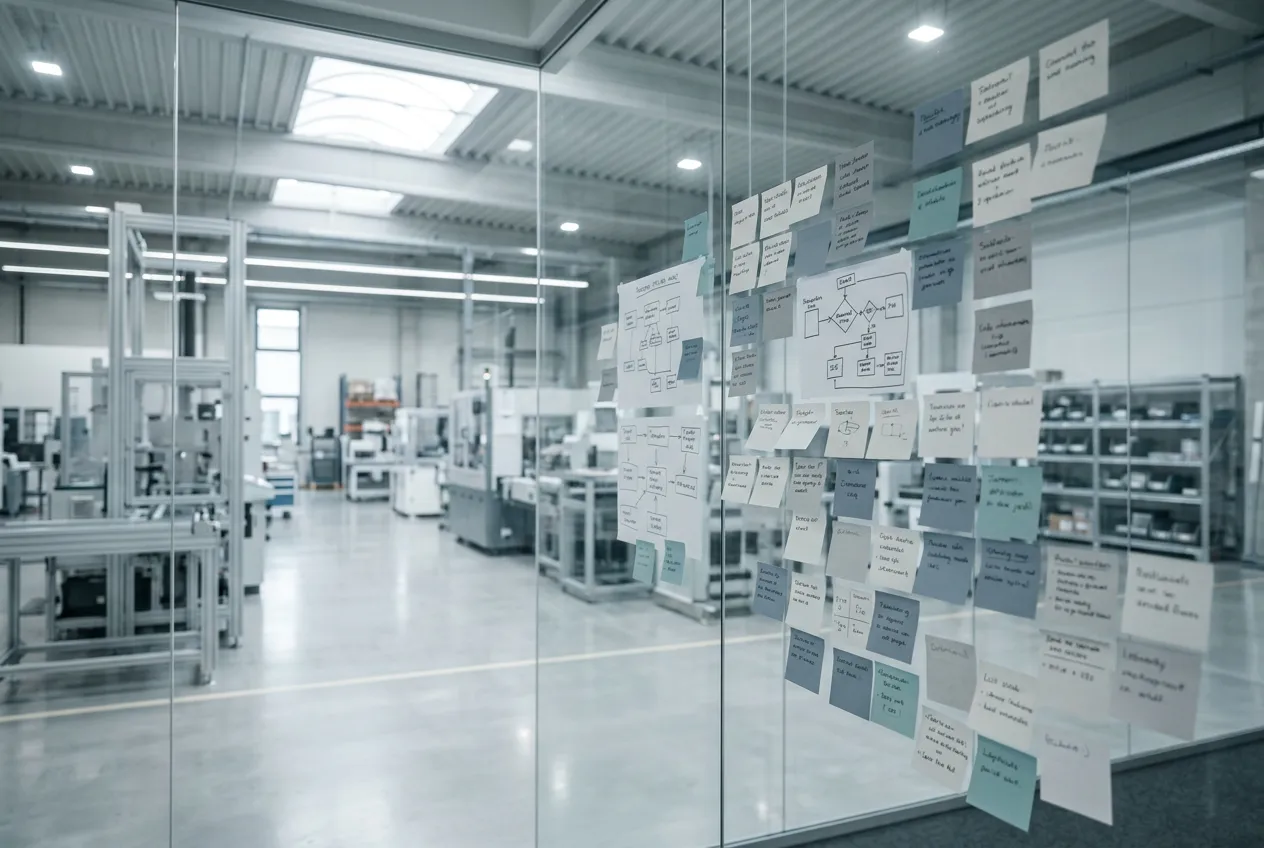

Artificial intelligence doesn't make bad processes better, it just makes them bad faster. Before agents can truly be effective, clean data flows, clear responsibilities, and well-thought-out processes are essential. This is precisely where our consulting expertise comes in: We analyze existing structures, fix breaks at their root, and build the foundation upon which AI can scale sustainably. This ensures that you don't end up with isolated solutions, but rather a robust foundation for your company's AI future.
In most companies, the relevant knowledge already exists, but it's scattered across ERP, email inboxes, SharePoint, supplier portals, and tickets. Agent-based AI specifically accesses these sources, combines the information contextually, and provides a reliable answer instead of a list of hits. This transforms fragmented data into actionable knowledge - without data migration and without a new system.
Many processes fail not due to individual steps, but due to the handovers in between - between departments, systems, and external partners. Agentic AI takes over precisely this coordination: Agents read incoming requests, prepare subsequent steps, initiate actions in other systems, and only escalate where a human decision is required. The team focuses on exceptions, not routine tasks.

Agents take over partially automated routine tasks in purchasing, scheduling, order processing, etc., relieving your team.
Integrated AI reduces search and coordination efforts and makes relevant information immediately usable. Data from various systems is provided as a basis for decision-making.
Agent-based AI integrates with existing ERP, EDI, and cloud environments, connecting information across system boundaries. This creates seamless processes, without migration, without parallel systems, and without vendor lock-in.
Data storage in EU data centers, ISO 27001, and ISO 42001 provide the foundation for secure and compliant AI deployment.
Process consulting and AI combines process advisory work with artificial intelligence for manufacturing companies. The principle: AI does not make poor processes better, only faster. Digitalisation consulting therefore comes first, ordering data flows, responsibilities and procedures before technology is introduced. On that basis, AI use cases are identified, assessed and implemented, from potential analysis through pilot projects to productive operation.
Proven AI use cases in manufacturing sit where data is plentiful and decisions recur: predictive quality, anomaly detection in process and measurement data, predictive maintenance, visual inspection through image recognition, automated root cause analysis, forecasting for demand and stock, and optimisation of changeover sequences. Machine learning in manufacturing pays off particularly with high product variance or expensive scrap. The best entry point is rarely the most spectacular use case, but the one with data already available.
Identifying AI use cases starts with processes, not technology: where do costs arise through scrap, downtime, manual work or late decisions? Where does data already exist that is not being used? This produces a longlist, assessed by benefit, data availability, effort and risk. Two or three candidates remain for a pilot. A structured AI potential analysis or an AI workshop with both business and IT participants delivers the result within a few days.
An AI potential analysis is a structured assessment of which processes can benefit from artificial intelligence and which prerequisites are in place. It examines the process landscape, existing data sources and their quality, IT systems and interfaces, and team capabilities. The result is a rated list of use cases with estimated benefit, effort and a recommended sequence. Unlike pure technology advice, it also reveals where processes or data need cleaning up first.
An AI workshop brings business units, IT and management together to build a shared understanding within one or two days: what AI can realistically achieve in your production, where concrete applications lie, and what is missing for implementation. A typical agenda: an overview of current AI methods using practical examples, collection and assessment of your own use cases, a review of the data basis, prioritisation by benefit and effort. The outcome is a roadmap with one to three pilots.
An AI pilot project in production should be small, measurable and time-boxed: one process, one question, one clearly defined success measure such as the detection rate for deviations. First the required data is consolidated and checked for quality, then a first model is trained and validated against real data. Involving the users early matters. After eight to twelve weeks there is usually a reliable answer on whether the use case should go into production.
Predictive quality is the use of data analysis and machine learning to predict quality problems before defective parts are produced. Instead of checking quality after manufacturing, process parameters, machine data, measured values and ambient conditions are evaluated continuously and related to historical quality results. The model recognises patterns that indicate emerging deviations. AI in quality assurance complements classic SPC: control charts show that a process is drifting, predictive quality shows why.
Both approaches use the same methods but answer different questions. Predictive maintenance forecasts when a machine or component will fail, so maintenance can be planned in time; the data basis is vibration, temperature, current and operating hours. Predictive quality forecasts whether the manufactured part will meet requirements; the data basis is process parameters and measurement data. Before introducing predictive maintenance, check whether quality data is the easier entry point, since it often already exists.
Anomaly detection in production data means using statistical and machine learning methods to automatically find values, patterns or trends that deviate from a process's normal behaviour, even when no fixed limit is breached. Classic tolerances only show whether a value is inside or outside. An anomaly model instead learns the typical interplay of many characteristics and reacts when a combination is unusual, for example a gradual drift or a supplier whose values change systematically.
Machine learning in manufacturing does not need perfect data, but enough consistent data with context. Specifically: process and machine data, quality and measurement data per part or batch, master data on article, tool, machine and supplier, and a clean link through timestamps or order numbers. What matters is that inputs and outcomes can be connected. Projects usually fail not on the algorithm but on data sitting in separate systems without a shared key.
The ROI of digitalisation in production is calculated by setting investment and operating costs against measurable effects: less scrap and rework, fewer stoppages, manual data entry saved, avoided complaint and expedited freight costs, and shorter lead times. It is essential to measure a baseline before the project, otherwise the effect cannot be evidenced later. A proven approach is to start with one bounded use case and verify its benefit with real data after rollout.
A digitalisation roadmap is the sequenced plan for how a company develops its production and IT landscape: from stocktaking through prioritised projects to the target picture. Creating one starts with recording processes, systems and data flows and naming the pain points. From this an IT strategy for manufacturing is derived, defining which systems stay, which are replaced and how data should flow. Projects are then ordered into waves by benefit, dependency and capacity, and reviewed twice a year.
Smart factory and Industry 4.0 describe manufacturing in which machines, systems and people are connected through data and processes can be steered transparently. For mid-sized companies this does not mean rebuilding the plant. Smart factory solutions start practically: connecting existing machines, capturing production and quality data centrally, and deriving metrics and alerts from it. Industry 4.0 software should be open, supporting standards such as OPC UA, and run as SaaS without a server landscape of your own.
An interim CIO (also acting CIO) takes temporary responsibility for a company's IT strategy and IT organisation without a permanent leadership post being filled. In mid-sized companies this makes sense when the business is growing, a system change is due, or IT has so far been run on the side. The interim CIO orders the system landscape and responsibilities, evaluates vendors, steers projects and builds structures that keep running after they leave. metrologx offers this role together with process consulting.
Scaling production processes means building procedures, quality assurance and IT systems so that they grow with rising volumes, without every growth step turning into a new IT project. What works in prototyping with experience and spreadsheets fails in small series for lack of standards: bills of material, inspection plans, feedback and supplier processes have to be defined and system-supported. A discovery workshop that records the current state, describes target processes and derives a roadmap has proven effective.
Schedule a technical demo and see firsthand how our solution addresses your specific challenges.